Quality Management Analytics.
SAP QM operational data — customer complaints, defect records, quality decisions, cutting logs — was fragmented across dozens of tables and production plants. I designed an ABAP CDS-based analytical data foundation that transforms it into structured, business-readable datasets consumed by Power BI dashboards for quality monitoring, defect analysis and operational decision tracking.
From scattered QM tables to a quality analytics platform.
Quality data in SAP lives in many places: notifications, defect items, defect codes, custom quality-process tables, material masters, customer masters — spread across multiple production plants, each with its own process nuances. Raw SAP records are technically complete but not analytically useful.
The project's core job was to model this data for analytical consumption. Multiple ABAP CDS views were designed to join, enrich and expose QM data in a shape that Power BI can consume directly — with business-readable field names, translated decision codes and cross-table context that the source records lack on their own.
The result: a set of Power BI dashboards covering customer complaints, reclamation trends, finishing quality ratios, cutting-log decisions and plant-level quality outcomes — all fed by a reusable CDS data layer sitting inside SAP.
Why it was built.
Quality data was fragmented and unreadable for BI.
Customer complaints, defect items, defect code descriptions, quality decisions, cutting logs and handling-unit records were tracked across different SAP standard and custom tables — each with raw codes instead of business-readable labels. Business users couldn't analyze quality trends, compare defect patterns across plants, or spot recurring problems without manually cross-referencing multiple transactions. Power BI had no usable data layer to connect to.
A CDS-based analytical data foundation.
Multiple ABAP CDS views were designed to join, enrich and expose QM data for Power BI. Notification headers meet defect items, defect code texts meet material and customer masters, operational decision codes become readable categories — all modeled as structured, plant-aware analytical datasets that Power BI consumes directly. Business users now monitor quality from dashboards instead of transactions.
Four analytical domains, one data flow.
SAP QM tables and custom quality-process tables flow through ABAP CDS views into Power BI's semantic model and out to dashboards.
SAP QM Tables
QMEL · QMFE · QPCT + custom Z tables
ABAP CDS Views
Join · enrich · translate codes
Power BI Model
Measures · relationships · DAX
Dashboards
KPIs · charts · drill-downs
Customer Complaints & Reclamations
Notification headers, defect items, defect code texts, material master and customer master joined into a single analytical dataset for complaint trend and reclamation analysis.
Finishing Quality Status
First-quality and second-quality ratios, total defects, defect percentages and defect-type distribution — finishing, weaving, sewing and hole defects with per-type metering.
Cutting Log & Rework Decisions
Cutting-log records with old/new handling units, old/new batches, personnel, customer context and decision codes translated to business categories: alteration, 2nd quality, store, return to production.
Plant-Specific Quality Decisions
Handling-unit and quality-decision data modeled per production plant (1200, 1300, 1400) to account for plant-specific process fields, inspection types and defect-code structures.
What business users see.
Customer Complaint & Reclamation Analytics
Power BI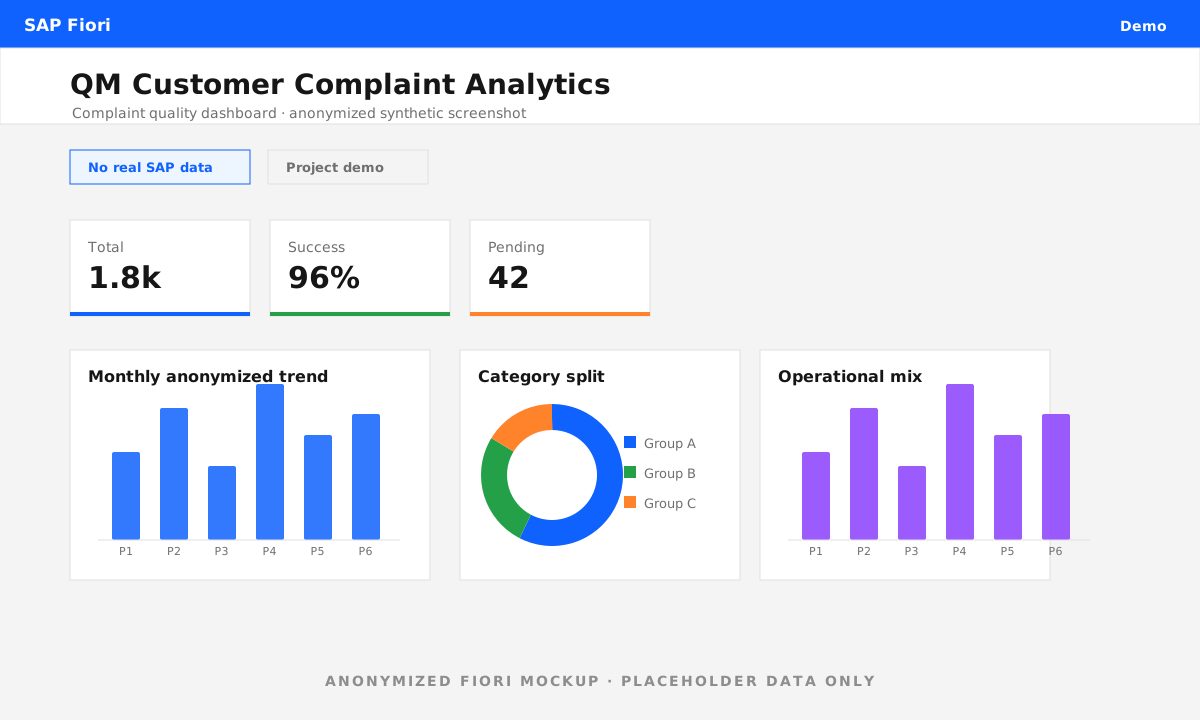
Cutting Log & Decision Analytics
Power BI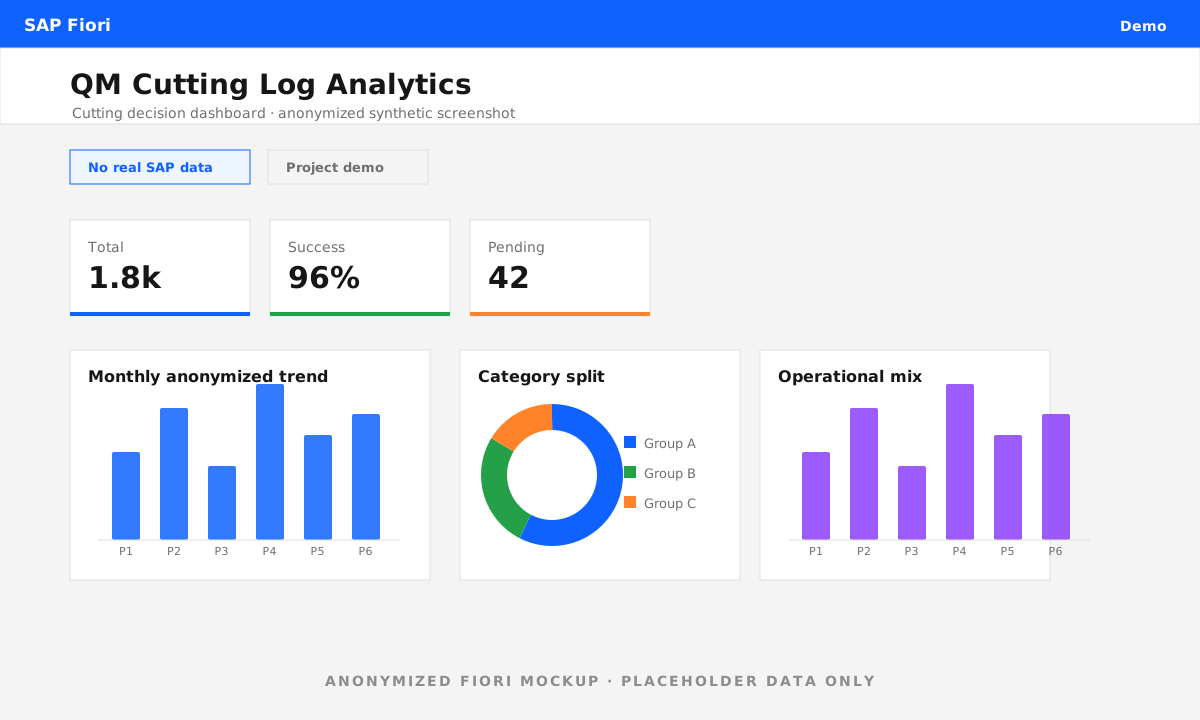
What I built.
From the CDS data models in SAP through to the Power BI dashboard design — the full analytical stack.
- ABAP CDS analytical views — multiple views joining SAP QM standard tables with custom quality-process tables for Power BI consumption.
- Cross-table enrichment — defect code texts, material masters, customer masters and production-order context joined at the CDS layer.
- Business-readable mappings — operational decision codes translated into human-readable categories directly in the data model.
- Plant-specific data models — separate CDS views per production plant to account for different process fields and inspection types.
- Power BI dashboard design — KPI cards, trend charts, distribution visuals, treemaps, comparison views and analytical notes.
- End-to-end data flow — SAP tables → CDS views → OData/service layer → Power BI semantic model → interactive dashboards.
The impact.
QM data became centrally visible through Power BI instead of scattered across SAP transactions. Raw SAP records were transformed into business-readable analytical datasets. Customer complaint trends, defect-type distributions, quality ratios and rework decisions became monitorable from a single dashboard. Recurring defect patterns and customer-concentration risks became easy to spot. And the CDS data foundation is reusable — new dashboards or reporting layers can consume the same models without rebuilding the data logic.
See the other flagship deliveries.
One of 15 case studies delivered at Akça Holding. The Osman Akça logistics platform and IKEA SPI forecast suite sit right alongside it.